Home Loan Estimator: Calculate Your Monthly Payment, Interest & Total Cost
Use this free home loan estimator to calculate your monthly payment, total interest and loan cost. See how rate and term change what you pay.
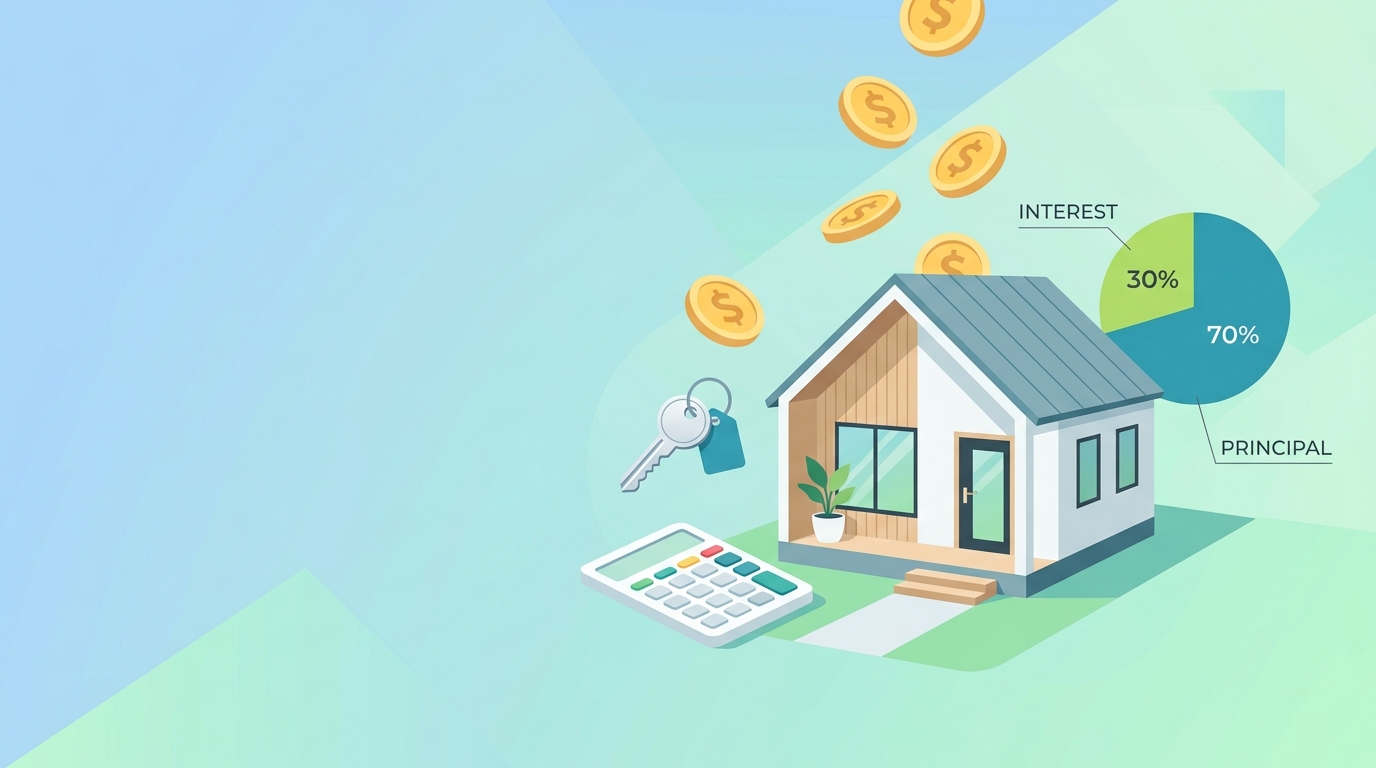
A home loan estimator tells you what you will pay each month for a home loan, how much interest you will pay in total, and how rate and term change the cost. Enter the loan amount, interest rate, and loan term, and you get your monthly payment (often called EMI) in seconds.
Use it before you talk to a lender so you know what is realistic. Below, you will see exactly how the math works, real examples, and the extra costs that most estimators miss.
How to use the home loan estimator (4 steps)
Estimate your monthly mortgage payments in four straightforward steps:
Enter the loan amount
This is the final purchase price of the property minus your upfront down payment.
Enter annual interest rate
Input the annual percentage rate (APR) quoted by your bank, broker, or financial institution.
Choose the loan term
Select the repayment duration in years—standard terms are 15, 20, 25, or 30 years.
Inspect total cost breakdown
Immediately review your monthly payment (EMI), lifetime interest paid, and total principal repaid.
What affects your home loan payment?
Several key parameters dictate your monthly installment and cumulative interest costs:
| Factor | What it does | How you can influence it |
|---|---|---|
| Loan amount | Larger loan directly results in a larger monthly payment | Save a larger upfront down payment (e.g., 20% to avoid PMI) |
| Interest rate | The single biggest driver of lifetime loan costs | Boost your credit score and compare quotes across at least 3 lenders |
| Loan term | Longer term lowers monthly cost but massively increases total interest | Pick the shortest term your monthly cash flow can comfortably support |
| Rate type | Fixed stays constant; adjustable/variable can rise over time | Stress-test your budget against rate hikes if choosing variable |
| Extra payments | Directly reduces remaining principal balance early | Contribute an extra fixed monthly amount or biweekly payments |
How is a home loan payment calculated?
Standard fixed-rate mortgages and home loans utilize the standard amortization formula to calculate equal monthly installments (EMI):
Monthly payment (EMI) = P × r × (1 + r)ⁿ ÷ [(1 + r)ⁿ − 1]
You never need to compute this by hand—our estimator handles the exponents instantly. Understanding the formula reveals why even an eighth of a percent (0.125%) rate cut creates dramatic lifetime savings over 360 payments.
Example: a 300,000 home loan at different rates
To see the real-world impact of interest rates, look at a 300,000 loan over a 30-year term (the numbers apply equally in dollars, pounds, euros, or rupees):
| Interest rate | Monthly payment (EMI) | Total interest paid | Total repaid (P + I) |
|---|---|---|---|
| 5.0% | 1,610 | about 279,800 | about 579,800 |
| 6.0% | 1,799 | about 347,500 | about 647,500 |
| 7.0% | 1,996 | about 418,500 | about 718,500 |
Moving from 5% to 7% adds roughly 386 per month and an eye-watering 138,700 in extra interest over the life of the mortgage. This is why spending time shopping around and negotiating loan points yields an immense return on investment.
Shorter term vs longer term: what is the trade-off?
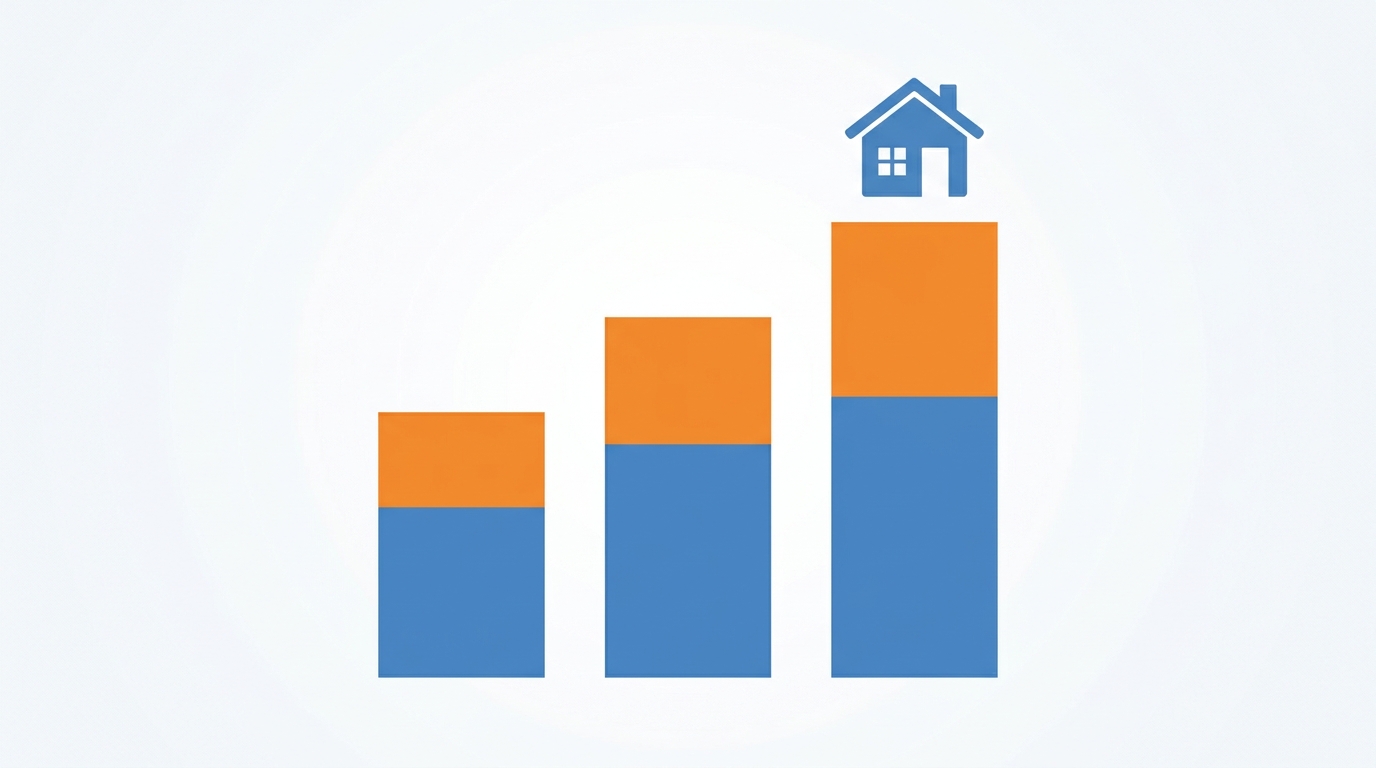
Comparing the same 300,000 home loan at 6.0% across 15, 20, and 30-year terms:
| Loan term | Monthly payment | Total interest | Best suited for |
|---|---|---|---|
| 30 years | 1,799 | about 347,500 | Maximum monthly cash flow flexibility |
| 20 years | 2,149 | about 215,800 | Balanced amortization and manageable budget |
| 15 years | 2,532 | about 155,700 | Fastest debt freedom & lowest total interest |
Choosing a 15-year mortgage over a 30-year term saves an incredible 191,800 in interest, but increases your monthly payment by 733. The best term is the shortest duration that still leaves an emergency cash buffer in your monthly budget.
How the first payments are split (Amortization)
In the early years of any fixed-rate loan, the vast majority of your monthly payment goes toward interest charges rather than reducing your debt:
| Part of first monthly payment (1,799 total) | Amount | Share of payment |
|---|---|---|
| Interest (Paid to lender) | 1,500 | 83.4% |
| Principal (Equity building) | about 299 | 16.6% |
Over time, as the remaining principal balance shrinks, the monthly interest portion decreases and the equity portion expands. This amortization curve is precisely why making voluntary extra principal payments in years 1–5 saves thousands in compound interest.
The costs a basic estimator leaves out
Your true monthly housing cost is almost always higher than pure principal and interest:
| Extra cost | Typical form | Planning guidance |
|---|---|---|
| Property taxes | Annual municipal tax divided into monthly escrow | Check county records for local property tax rates |
| Homeowners insurance | Annual insurance premium in escrow | Get insurance quotes before closing |
| Mortgage Insurance (PMI) | Required if down payment is below 20% | Typically 0.3% to 1.5% of original loan amount annually |
| Processing & origination fees | One-time loan closing costs | Request a comprehensive Loan Estimate document from lender |
| Maintenance & repairs | Ongoing repairs, roof, HVAC, plumbing | Budget 1% of home market value each year for repairs |
| HOA or maintenance dues | Monthly condominium or subdivision dues | Confirm HOA fees and historical assessment increases with seller |

How much can you save with extra payments?
Adding just 100 per month extra principal to that 300,000 loan at 6% over 30 years yields astonishing results:
You pay off the loan in 26 years and 1 month instead of the full 30 years.
That is pure profit staying in your pocket instead of flowing to bank interest.
Tip: Always verify with your lender that any extra payments are explicitly applied to your principal balance and that your loan carries zero prepayment penalties.
How much home loan can you afford?
Financial advisors recommend the classic 28/36 rule as a prudent affordability guideline:
- Front-end ratio (28%): Total monthly housing costs (principal, interest, property taxes, home insurance, HOA) should not exceed 28% of your gross monthly pre-tax income.
- Back-end ratio (36%): Total monthly debt obligations (housing + student loans, car loans, minimum credit card payments) should not exceed 36% of gross monthly income.
6 ways to lower your home loan cost
1. Save a larger down payment
Putting down 20% eliminates costly mortgage insurance (PMI).
2. Compare at least three lenders
Rates and closing fee structures vary widely between lenders.
3. Improve your credit score
Higher credit tiers unlock the lowest tier interest rate brackets.
4. Choose the shortest term affordable
15 or 20-year loans slash total interest expenses in half.
5. Make extra principal payments
Even a small extra monthly contribution cuts years off the amortization schedule.
6. Evaluate refinancing
If benchmark market rates fall 1% or more below your note rate, refinancing can pay off.
Frequently asked questions
What is a home loan estimator?
It is a financial tool that computes your exact monthly mortgage payment, cumulative interest charges, and total loan cost based on the borrowing amount, annual percentage rate, and term length.
What is EMI in a home loan?
EMI stands for Equated Monthly Installment. It is the fixed payment amount made by a borrower to a lender on a specified date each calendar month, combining both interest charges and principal reduction.
Is a home loan estimator accurate?
It is mathematically 100% accurate for principal and interest on a fixed-rate schedule. Keep in mind that local real estate taxes, hazard insurance, and HOA dues will be billed on top of this basic amount.
How is home loan interest calculated?
Interest is charged monthly based on the outstanding principal balance. Because the balance is highest at the beginning of the loan, early payments are heavily weighted toward interest rather than principal repayment.
What interest rate should I enter?
Enter the prevailing market rate quoted by lenders for your credit tier. Test three rates: your base quoted rate, a 0.5% lower rate, and a 1.0% higher rate to see your payment sensitivity.
Does the estimator work for auto or personal loans?
Yes. The fixed-rate amortization math is identical for auto loans, student loans, or unsecured personal loans. Simply input that loan's principal amount, interest rate, and term in years.
Estimate your home loan now
Test combinations: compare a 15-year vs 30-year term, see the difference a 0.5% rate reduction makes, and budget accurately before signing loan documents.
Disclaimer: This article and estimator are for educational and informational purposes only. Actual loan terms, qualification guidelines, and monthly fees are determined solely by lending institutions.
Explore All 140+ Free Tools
PixForgeStudio offers 140+ free browser-based tools: PDF editor & viewer, image compressor, video trimmer, audio transcriber, converters, and calculators. 100% private — zero file uploads.
Browse All Tools