Retirement Calculator: How Much Do You Need to Retire? (2026 Guide)
Free retirement calculator: enter your age, savings and monthly contributions to see your projected nest egg and whether you're on track. No signup.

A retirement calculator estimates how much money you could have when you stop working, and whether that is enough to cover your expenses. Enter your age, current savings, monthly contributions, and expected return, and you get a projected balance in seconds.
This guide shows you how to use it, what the numbers really mean, a worked example, and the 2026 contribution limits so you can save as much as the tax rules allow.
How to use the retirement calculator (4 steps)
Planning your retirement savings doesn't require complex financial formulas. With our free online calculator, you can evaluate your savings path in four simple steps:
Enter current & target retirement age
This determines your investment time horizon—how many years your money has to benefit from compound growth.
Add your current savings
Include your 401(k), traditional or Roth IRA, personal brokerage accounts, and existing retirement assets.
Enter your monthly contribution
Input what you save every month, including employer matching contributions or scheduled annual pay raises.
Set your expected return rate
See your projected nest egg immediately. Compare conservative (4%), moderate (6%), and growth (8%) return rates.
What does a simple retirement calculator need from you?
Understanding each field ensures your projection reflects your real financial reality:
| Input | What it means | Pro Tip |
|---|---|---|
| Current age | Starting point of the projection | Use your real chronological age today |
| Retirement age | When you stop adding money and start spending it | Moving it just 2 years later significantly increases your final balance |
| Current savings | What you have saved today | Combine all retirement and long-term investment accounts |
| Monthly contribution | What you add to your portfolio each month | Include employer matching dollars (it is free compensation!) |
| Expected return | Average yearly growth of your investments | Be conservative. Test several rates (4%, 6%, 8%) |
| Inflation | How fast consumer prices and cost of living rise | About 2% to 3% is the standard long-term benchmark |
A retirement calculator shows a scenario, not a guarantee. Real-world market returns fluctuate year to year, and the further out into the future you look, the more your compounding assumptions matter.
Worked example: what $600 a month could become
Let's look at a realistic scenario: Meet a 35-year-old saver who currently has $50,000 saved, contributes $600 every single month, and plans to retire at age 65 (a 30-year investing horizon).
| Average annual return | Projected balance at age 65 | What it represents |
|---|---|---|
| 4% (Conservative bond / income) | about $582,000 | Modest wealth preservation with minimal volatility |
| 6% (Balanced index portfolio) | about $904,000 | Diversified balanced portfolio matching historical trends |
| 8% (Equity-heavy stock portfolio) | about $1,441,000 | Higher long-term compounding with market volatility |
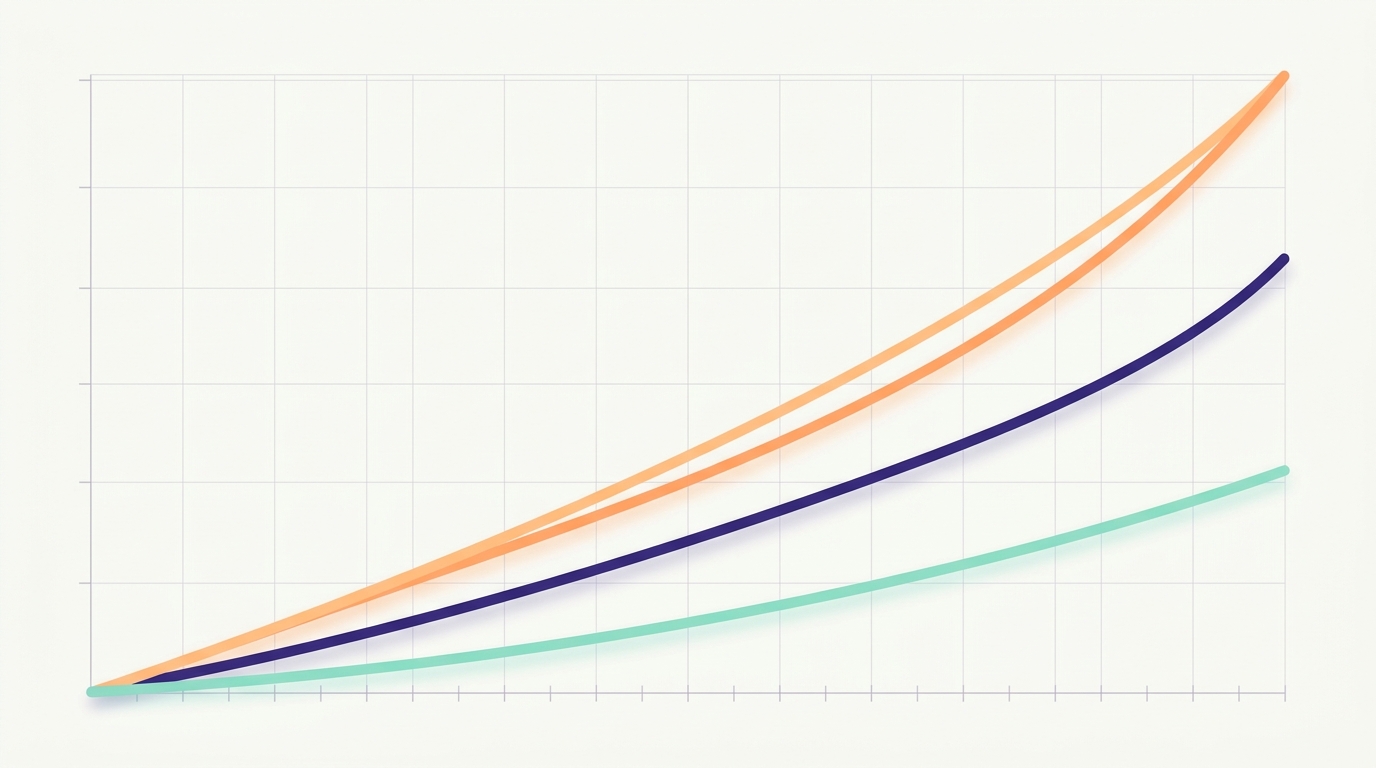
Notice the striking spread: a 4-point difference in annual return changes the final outcome by roughly $860,000. This demonstrates why investment calculators ask for an expected return rate, and why testing low, medium, and high cases is critical.
Adjusting for inflation: At a 6% nominal return and 3% inflation, your "real" purchasing power growth is roughly 3% annually. That same $50,000 initial balance plus $600 a month translates to roughly $472,000 in today's purchasing power. Because a million dollars in 30 years buys less than a million dollars today, always factor inflation into your retirement targets.
How much do you need to retire?
There is no single magic number that fits everyone, but two established financial planning benchmarks provide a dependable baseline:
- The 25x Rule: Multiply your expected annual spending in retirement by 25. For example, if you anticipate spending $40,000 per year, your target savings goal is $1,000,000.
- The 4% Guideline (Trinity Study): This is the 25x rule viewed from the withdrawal perspective. Withdrawing approximately 4% of your starting retirement portfolio in year one, adjusted upward for inflation each subsequent year, has historically sustained a 30-year retirement without running out of capital.
| Target annual retirement spending | Rough savings target (25x) | Safe monthly withdrawal (4% rule) |
|---|---|---|
| $30,000 / year | $750,000 | $2,500 / month |
| $40,000 / year | $1,000,000 | $3,333 / month |
| $60,000 / year | $1,500,000 | $5,000 / month |
| $80,000 / year | $2,000,000 | $6,667 / month |
Pro planning tip: Subtract guaranteed income sources (such as Social Security, government pensions, or rental annuity income) from your annual spending first. If you anticipate $20,000 per year from Social Security, you only need to fund the remaining $20,000 difference from your personal portfolio ($500,000 nest egg instead of $1,000,000).
Why starting early beats saving more later
Time is the single most powerful ingredient in wealth accumulation. To illustrate this, consider two savers who both contribute an identical $500 per month earning a 6% annual return until age 65:
| Saver | Starting age | Years saving | Total cash deposited | Balance at age 65 |
|---|---|---|---|---|
| Early Saver | Age 35 | 30 years | $180,000 | about $502,000 |
| Later Saver | Age 45 | 20 years | $120,000 | about $231,000 |
Waiting 10 years cuts the final balance by more than half ($231,000 vs $502,000), even though the monthly contribution was identical. If you are starting later in life, your most effective levers are increasing your monthly savings rate, working a year or two longer, and taking full advantage of catch-up contributions. You can also model your growth curve with our Compound Interest Calculator.

2026 retirement contribution limits (US)
The IRS adjusted tax-advantaged account contribution limits for 2026. Here are the active figures to plug into your savings strategy:
| Account type | Standard limit | Catch-up (Age 50+) | Special catch-up (Ages 60–63) |
|---|---|---|---|
| 401(k), 403(b), 457 plans, TSP | $24,500 | +$8,000 (total $32,500) | +$11,250 (total $35,750) |
| Traditional or Roth IRA | $7,500 | +$1,100 (total $8,600) | Same as 50+ ($8,600) |
| SIMPLE IRA | $17,000 | +$4,000 | Higher tier applies under SECURE 2.0 |
Two essential rules to remember:
- Employer matching contributions do not count toward your individual $24,500 limit. Always contribute at least enough to capture your full employer 401(k) match.
- Under recent SECURE 2.0 tax rules, catch-up contributions for savers whose previous-year wages exceeded $150,000 must be made on a post-tax Roth basis.
5 common retirement calculator mistakes
Avoid these common pitfalls when interpreting your numbers:
| Mistake | Why it hurts your plan | The Fix |
|---|---|---|
| Using one optimistic return rate | Real market returns fluctuate and suffer market downturns | Test 4%, 6%, and 8% scenarios |
| Ignoring inflation | Overstates your future dollar purchasing power | Evaluate inflation-adjusted "today's dollars" |
| Forgetting retirement taxes | Traditional 401(k) withdrawals are taxed as ordinary income | Factor an effective tax rate (15–22%) into budgets |
| Skipping healthcare & Medicare | Out-of-pocket medical costs rise with age | Include dedicated healthcare funds or an HSA |
| Planning only to age 80 or 85 | Many retirees live into their 90s, risking running out of funds | Model your savings longevity to age 95 |
Frequently asked questions
How accurate is a retirement calculator?
A retirement calculator is as accurate as the assumptions you provide. It accurately computes compounding mathematics, but cannot predict future inflation, market fluctuations, tax code changes, or personal healthcare expenses. Treat the result as a dynamic roadmap and recalculate once or twice a year.
How much should I save each month for retirement?
A standard baseline is 10% to 15% of your gross income, which includes your personal contributions plus any employer matching dollars. If you are starting in your 40s or 50s, you will typically need to increase contributions to 20% or more to reach the same target.
What is a simple retirement calculator?
A simple retirement calculator focuses on the foundational levers: age, current portfolio balance, monthly additions, and expected rate of return. Unlike complex financial advisory software, it delivers immediate clarity in seconds without requiring personal account logins or financial disclosures.
How do I calculate retirement savings by hand?
You can calculate future value using the compound interest and annuity formula:FV = PV × (1 + r)^n + PMT × [((1 + r/12)^(12n) - 1) / (r/12)]
Where PV is current savings, PMT is monthly contribution, r is annual interest rate, and n is years to retirement. Our calculator runs this calculation instantaneously.
Is the 4% rule still safe today?
The 4% rule remains a proven baseline for a standard 30-year retirement. However, adopting a flexible withdrawal rate—such as trimming discretionary spending slightly during down market years—greatly improves portfolio survival rates over 35 to 40 years.
Is this a retirement fund calculator or financial advice?
This is a free mathematical planning tool designed for informational and educational purposes. For specific tax strategies, estate planning, or individualized investment advice, always consult a certified financial planner (CFP) or tax professional.
Check your retirement number now
Test different scenarios: see what happens if you delay retirement by two years, increase your monthly deposit by $100, or choose a conservative return rate. Small changes today make an enormous difference over time.
Disclaimer: This article and calculator are for general informational purposes only and do not constitute financial, investment, or tax advice.
Explore All 140+ Free Tools
PixForgeStudio offers 140+ free browser-based tools: PDF editor & viewer, image compressor, video trimmer, audio transcriber, converters, and calculators. 100% private — zero file uploads.
Browse All Tools